

Gomed is one of the most talked-about stones in Vedic astrology. Its warm honey-to-cinnamon colour makes it easy to like, but the real question buyers ask is simple: can anyone wear Gomed? The short answer is no — at least not according to the tradition the stone comes from. This guide explains what the Gomed gemstone is, why it is worn, who it is traditionally recommended for, and how to check quality before you buy or stock it.
What Is the Gomed Gemstone?
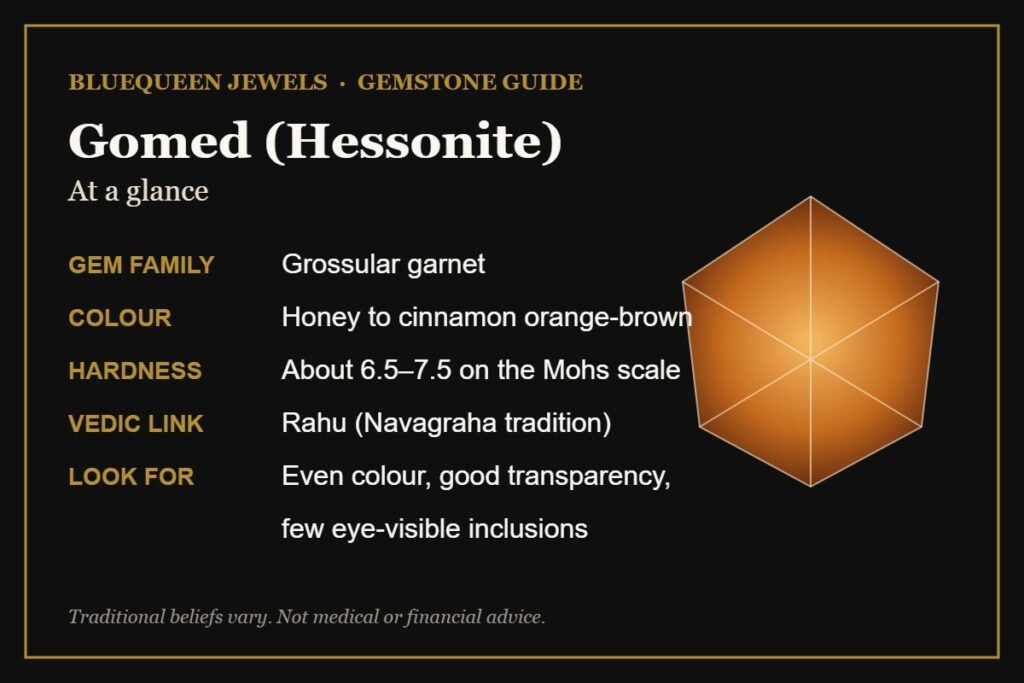
In gemology, Gomed is called hessonite, a variety of grossular garnet. Its colour ranges from yellowish-orange to deep brownish-red. Under a loupe, many hessonites show a swirly, “heat-wave” or treacle-like texture inside the stone — a well-known identifying feature that gemologists use to tell it apart from look-alikes.
Hessonite sits at roughly 7 to 7.5 on the Mohs hardness scale, so it is durable enough for rings and pendants worn regularly, as long as it is protected from hard knocks. Most commercial material comes from Sri Lanka, with other sources in India and East Africa.
Gemologically, the Gomed gemstone belongs to the garnet group. The GIA garnet guide explains that grossular is one of the five commercially important garnet species. Hessonite is the warm, honey-to-cinnamon coloured variety of grossular garnet.
Why Is Gomed Linked With Rahu?
In Vedic astrology (Jyotish), Gomed is the stone associated with Rahu, the shadow planet linked with ambition, illusion, sudden events and confusion. The traditional belief is that wearing Gomed helps calm the unsettling side of Rahu and channel its energy in a more positive direction. It is one of the nine stones of the Navaratna set.
Please note: these are traditional and spiritual beliefs. They are not scientific or medical claims, and no gemstone can guarantee a result.
Traditional Benefits People Associate With Gomed
People who wear Gomed for astrological reasons usually hope for:
- Clearer thinking — less mental fog and better decisions.
- Career momentum — help overcoming obstacles, especially in competitive fields.
- Emotional steadiness — feeling less anxious or fearful about the unknown.
- Protection — a shield against negative influences and sudden setbacks.
Traditionally it is popular with people in law, politics, media, technology and business — fields where quick thinking and a competitive edge matter.
Can Anyone Wear Gomed?
Not as a rule. In Jyotish, Gomed is considered a strong stone and is normally worn only after a birth chart has been checked. Wearing it “just because it looks nice” is fine as fashion jewelry, but people wearing it for astrological reasons are usually advised to get a reading first.
Who traditionally considers Gomed
- People whose astrologer says Rahu is weak or troublesome in their chart.
- People running a Rahu Mahadasha or Antardasha, if their astrologer recommends it.
- People whose chart supports Rahu-related strengths, for example in careers that reward bold, unconventional thinking.
Who is usually told to avoid or wait
- Anyone whose astrologer has not recommended it — tradition holds that an unneeded strong stone can upset balance.
- People who feel restless, uneasy or unwell while trying the stone (the usual advice is to remove it and consult again).
- People already wearing stones that astrologers consider incompatible with Gomed. Combinations with Ruby (Sun), Pearl (Moon) or Red Coral (Mars) are commonly discouraged.
If you are a retailer, the most trust-building thing you can do is say this honestly. Suggesting a consultation, instead of pushing a sale, is what brings customers back.
How Gomed Is Traditionally Worn
Practices differ between astrologers, but common guidance includes:
- Metal: silver or panchdhatu (five-metal alloy) is most common; some prefer gold.
- Finger: usually the middle finger of the working hand.
- Day: many astrologers suggest Saturday; others choose a day based on the chart.
- Weight: astrologers often suggest a carat or ratti weight based on the person’s chart and body weight — there is no single correct number.
- Open-back setting: many buyers prefer the stone to touch the skin.
How to Check Gomed Quality Before Buying
Whether you are buying one ring or sourcing stones for your store, look at these five points:
- Colour: a clean, even honey, orange or cinnamon tone is most valued. Very dark or muddy stones are usually priced lower.
- Clarity: the swirly internal texture is normal and helps prove it is hessonite. Large cracks, chips or cloudy patches lower the value.
- Cut: a well-proportioned cut brings out brightness. Lopsided stones or windows (dull see-through centres) are a sign of a poor cut.
- Carat weight: bigger, clean stones cost more per carat. Choose weight based on the recommendation, not just size.
- Treatment and origin disclosure: ask whether the stone is natural and untreated, and where it comes from.
Watch out for imitations
Glass and synthetic materials are sometimes sold as Gomed. Glass often shows round gas bubbles and feels warmer to the touch. Orange zircon or other garnets can also be confused with hessonite. The safest route is a stone that comes with a report from a recognised gem laboratory, and a seller who states clearly what you are buying.
Gomed Care Tips
- Clean with lukewarm water, mild soap and a soft brush.
- Avoid harsh chemicals, perfume sprays and ultrasonic cleaners if the stone has fractures.
- Store it separately so harder stones like diamond or sapphire do not scratch it.
- Remove it during heavy work or gym sessions.
For more general care advice, see our jewelry care tips.
For Retailers: Selling Gomed With Confidence
Astrology and gemstone jewelry sells best when the customer trusts the seller. A few simple habits help:
- Explain the stone’s gemological identity (hessonite garnet) and its traditional meaning separately and honestly.
- Never promise results. Use phrases like “traditionally believed” or “worn for”.
- Recommend a consultation for buyers wearing it for astrological reasons.
- Offer certificates where possible and disclose any treatment.
If you are building a gemstone or astrology jewelry range, you may also like our guides on crystal jewelry and astrological significance and which crystals don’t go together.
Frequently Asked Questions
Is Gomed the same as hessonite?
Yes. Gomed is the traditional Indian name; hessonite garnet is the gemological name.
Can I wear Gomed without an astrologer’s advice?
As fashion jewelry, yes. For astrological purposes, tradition strongly recommends a birth-chart reading first.
Which finger is Gomed worn on?
Most commonly the middle finger, set in silver or panchdhatu, though astrologers may advise differently.
How can I tell if my Gomed is real?
Look for the typical swirly internal texture and ask for a report from a recognised gem lab. Bubbles and a glassy feel can point to an imitation.
Looking for Gemstone or Custom Jewelry?
Bluequeen Jewels manufactures custom jewelry for retailers and resellers in the USA, UK, Australia and beyond. If you want a gemstone ring, pendant or bracelet made to your design, share your idea with our custom jewelry team or explore our wholesale program.


