
Crystal jewelry is one of the most personal things people wear. A rose quartz bracelet can be a reminder to be kind to yourself. An amethyst pendant can mark a new start. A zodiac bracelet can be a thoughtful birthday gift. This guide explains what popular crystals mean, where those beliefs come from, how crystals connect to Western and Vedic astrology, and how to choose, care for and sell crystal jewelry well.
An honest note first: the “healing properties” in this article are traditional and spiritual beliefs, not medical facts. In a well-known study at Goldsmiths, University of London, 80 volunteers meditated with either real quartz or look-alike fakes, and both groups reported the same “crystal effects” — the researchers found no evidence of benefit beyond placebo (summary of the study). Crystal jewelry is not a substitute for medical or mental health care. Many people still love it for its beauty, symbolism and the intention it helps them hold — and that is what this guide is about.
What is crystal jewelry?
Crystal jewelry uses natural minerals and gemstones — such as quartz, tiger’s eye, garnet or lapis lazuli — set in rings, pendants and earrings, or strung as bead bracelets and malas. Most popular “healing crystals” are affordable semi-precious stones. Precious gems such as ruby, sapphire and emerald are also used, especially in Vedic astrology.
The most common styles are:
- Bead bracelets — stretch or knotted bracelets of polished round beads, often mixing several crystals for one intention (wealth, love, protection).
- Zodiac and rashi bracelets — crystal combinations linked to a sun sign or a Vedic moon sign.
- Pendants and raw-crystal necklaces — a single point, tumbled stone or cut gem.
- Gemstone rings — the traditional format for Vedic astrology gems, often set so the stone touches the skin.
Where crystal beliefs come from
People have given meaning to stones for thousands of years. Ancient Egyptians wore amulets and placed them with the dead. Ancient Greeks thought clear quartz was water frozen so hard it could never melt. In India, the Navaratna (“nine gems”) tradition links nine gemstones to the nine celestial bodies of Vedic astrology (Navaratna). The modern idea of “healing crystals” and chakra stones grew mainly from the New Age movement of the late 20th century.
That mix of history is why you will see different meanings for the same stone in different places. There is no single official list — meanings are cultural, not scientific.
Popular crystals and their traditional meanings
The table below lists the crystals buyers ask about most, the meaning each is traditionally given, and practical facts that matter for jewelry. Hardness uses the Mohs scale (10 is diamond); stones below about 6 scratch more easily in daily wear.
| Crystal | Traditional meaning | Color | Mohs hardness | Jewelry note |
|---|---|---|---|---|
| Amethyst | Calm, clarity, spiritual awareness | Purple | 7 | Can fade with long sun exposure |
| Rose quartz | Love, self-care, compassion | Pale pink | 7 | Popular for gifts and bracelets |
| Citrine | Abundance, confidence, success | Yellow to orange | 7 | Most citrine sold is heat-treated amethyst |
| Clear quartz | Focus, clarity; seen as an “amplifier” | Colorless | 7 | Often combined with other stones |
| Smoky quartz | Grounding, letting go of stress | Brown-gray | 7 | Common in Capricorn bracelets |
| Tiger’s eye | Courage, confidence, protection | Golden brown | About 7 | Durable, good for men’s bracelets |
| Black tourmaline | Protection, grounding | Black | 7–7.5 | Tough and good for daily wear |
| Pyrite | Wealth, willpower | Metallic gold | 6–6.5 | Keep dry; can tarnish |
| Garnet | Energy, commitment, passion | Deep red | 6.5–7.5 | Also January birthstone |
| Moonstone | Intuition, new beginnings, the Moon | Milky white with sheen | 6–6.5 | Avoid knocks |
| Lapis lazuli | Truth, wisdom, communication | Deep blue with gold flecks | 5–6 | Softer; avoid chemicals |
| Green aventurine | Luck, opportunity | Green | About 7 | Common in “lucky” bracelets |
| Jade | Harmony, prosperity, long life | Green (also other colors) | 5–6.5 | Very tough despite moderate hardness |
| Aquamarine | Calm, courage, the sea | Light blue | 7.5–8 | Also March birthstone |
| Labradorite | Transformation, intuition | Gray with blue-green flash | 6–6.5 | Flash shows best in cabochons |
Hardness figures: Mohs scale gemstone guide. Citrine treatment: citrine overview.
The benefits people value in crystal jewelry
Setting aside medical claims, crystal jewelry does offer real value to the people who wear it:
- A daily reminder of an intention. Many people wear a stone as a cue — to stay calm before a meeting, to focus on savings goals, or to remember a loved one.
- Mindfulness and ritual. Touching a bead bracelet or mala can be part of meditation, prayer or a breathing routine.
- Personal and cultural meaning. Zodiac, rashi and birthstone jewelry connects the wearer to their sign, faith or family traditions.
- Meaningful gifting. A crystal chosen for someone’s sign or life moment feels more personal than a generic gift.
- Style. Natural stones add color and texture, and bead bracelets stack easily with watches and chains.
Some people describe emotional benefits — feeling calmer or more confident. If that happens, it is likely the power of ritual and belief rather than the mineral itself, and that is fine to enjoy. What crystal jewelry should never do is replace a doctor, therapist or medication.
Crystals and astrology: zodiac signs
In Western astrology, crystals are often paired with the 12 sun signs. Lists vary between sources, so treat these as common associations, not fixed rules.
| Sign | Dates (approx.) | Commonly associated crystals |
|---|---|---|
| Aries | Mar 21 – Apr 19 | Carnelian, red jasper, clear quartz |
| Taurus | Apr 20 – May 20 | Rose quartz, green aventurine, emerald |
| Gemini | May 21 – Jun 20 | Citrine, clear quartz, agate |
| Cancer | Jun 21 – Jul 22 | Moonstone, pearl, selenite |
| Leo | Jul 23 – Aug 22 | Tiger’s eye, citrine, sunstone |
| Virgo | Aug 23 – Sep 22 | Amazonite, moss agate, amethyst |
| Libra | Sep 23 – Oct 22 | Rose quartz, lapis lazuli, lepidolite |
| Scorpio | Oct 23 – Nov 21 | Obsidian, garnet, malachite |
| Sagittarius | Nov 22 – Dec 21 | Turquoise, lapis lazuli, sodalite |
| Capricorn | Dec 22 – Jan 19 | Garnet, smoky quartz, pyrite |
| Aquarius | Jan 20 – Feb 18 | Amethyst, aquamarine, labradorite |
| Pisces | Feb 19 – Mar 20 | Aquamarine, amethyst, moonstone |
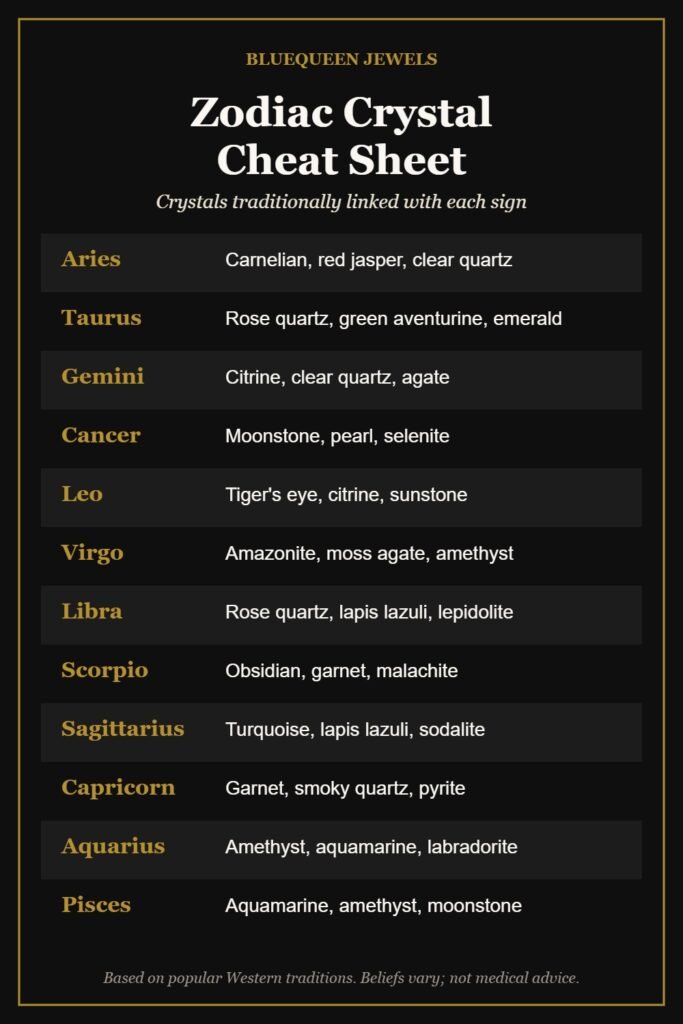
Want a quick reference? Save or pin this crystal jewelry cheat sheet for all 12 zodiac signs.
Crystals in Vedic astrology: the Navaratna and planetary gems
Vedic (Indian) astrology uses gemstones differently. Each of the nine celestial bodies, or navagraha, has a traditional gem (Navaratna):
| Planet | Sanskrit name | Traditional gem |
|---|---|---|
| Sun | Surya | Ruby |
| Moon | Chandra | Pearl |
| Mars | Mangala | Red coral |
| Mercury | Budha | Emerald |
| Jupiter | Brihaspati | Yellow sapphire |
| Venus | Shukra | Diamond |
| Saturn | Shani | Blue sapphire |
| Rahu (north lunar node) | Rahu | Hessonite garnet |
| Ketu (south lunar node) | Ketu | Cat’s eye chrysoberyl |
In a traditional Navaratna piece, the ruby sits in the center for the Sun, with the other eight gems around it. In Vedic practice, a single planetary gem is usually chosen by an astrologer after reading the wearer’s birth chart — for example, during a particular mahadasha (planetary period). Because of that, many people prefer to consult an astrologer before wearing a strong planetary stone such as blue sapphire.
Alongside these precious gems, rashi bracelets (for the 12 Vedic moon signs) and mahadasha bracelets made from semi-precious beads have become popular as an affordable, everyday way to wear these traditions.
How to choose good-quality crystal jewelry
- Ask about treatments. Dyeing, heating and stabilizing are common. Much turquoise on the market is stabilized or dyed stone, and most citrine is heat-treated amethyst. Treated stones are fine — they just should be disclosed.
- Watch for look-alikes. Glass, resin and dyed howlite are sometimes sold as natural crystals. Very uniform color and bubbles are warning signs.
- Check bead quality. Look for even size, smooth drilling and consistent color across the strand.
- Check the stringing. Good stretch bracelets use strong, double-strand elastic with a hidden, glued knot.
- Check the metal. Spacers and charms in 925 sterling silver or gold last far longer than plated base metal.
- Buy from a seller who explains their sourcing and names the stones accurately.
How to care for crystal jewelry
- Take bracelets off before swimming, showering, exercise and cleaning with chemicals.
- Wipe with a soft, damp cloth and dry fully. Avoid ultrasonic cleaners for soft, porous or treated stones.
- Keep amethyst, rose quartz and other colored quartz out of strong sunlight for long periods to reduce fading.
- Store pieces separately so harder stones do not scratch softer ones such as lapis lazuli or pearl.
- Restring bead bracelets when the elastic starts to lose stretch.
- Many wearers “cleanse” crystals with moonlight, sound or smoke. These are symbolic rituals; for physical cleaning, a soft cloth is all you need. Avoid salt water on pyrite, pearl and soft stones.
For retailers: selling crystal jewelry responsibly
Crystal and gemstone bracelets are a strong gifting and add-on category for jewelry stores, spiritual shops and online sellers. To sell them well — and legally — keep a few rules in mind:
- Avoid health claims. In the US, the FTC expects health-related advertising claims to be backed by competent and reliable scientific evidence (FTC Health Products Compliance Guidance). Say “traditionally associated with calm”, not “cures anxiety”.
- Disclose treatments and materials — dyed, heated, stabilized, or synthetic.
- Tell the story. Meaning cards, zodiac details and gift boxes turn a simple bracelet into a gift.
- Offer sets and sizes. Zodiac collections, couple bracelets and multiple wrist sizes lift average order value.
Crystal and gemstone jewelry from Bluequeen Jewels
Alongside our diamond and moissanite jewelry, Bluequeen Jewels makes crystal bead bracelets in our own workshop in Surat, India — including zodiac and rashi bracelets, a mahadasha bracelet collection, and intention bracelets such as a wealth bracelet with citrine, jade, tiger’s eye, clear quartz and pyrite. For customers who value tradition, bracelets can be energised with a temple puja, and they are packed in premium gift boxes.
We work with retailers, resellers and private-label brands on custom designs, private-label packaging and wholesale orders. Contact us to talk through crystal combinations, sizes and quantities for your store.
Frequently asked questions
Do healing crystals really work?
There is no scientific evidence that crystals heal the body beyond a placebo effect. Many people still find crystal jewelry meaningful as a reminder of an intention, part of a ritual, or a link to their beliefs. It should never replace medical care.
Which crystal is best for beginners?
Clear quartz, rose quartz and amethyst are the most popular starting points. They are affordable, durable (7 on the Mohs scale) and widely available.
Which hand should I wear a crystal bracelet on?
Traditions differ. A common modern belief says the left hand “receives” and the right hand “gives” energy. In practice, choose the wrist where the bracelet is comfortable and safe from knocks.
What crystal is good for my zodiac sign?
Each sign has common associations — for example, garnet and smoky quartz for Capricorn, or moonstone for Cancer. Lists vary between sources, so pick the stone whose meaning and look speak to you.
Can I wear a gemstone for my planet without an astrologer?
Semi-precious rashi and zodiac bracelets are generally worn freely. For strong Vedic planetary gems such as blue sapphire, tradition recommends consulting an astrologer who has read your birth chart.
How do I know if a crystal is real?
Buy from sellers who name stones accurately and disclose treatments. Watch for perfectly uniform color, air bubbles (a sign of glass), and prices that seem too low. For valuable gems, ask for a lab report.


