
When buyers compare VVS vs VS diamonds, the question is usually the same: “Will anyone actually see the difference?” In most jewelry, the honest answer is no. Both grades describe diamonds whose tiny internal marks are hard to spot even under magnification. The difference shows up on the grading report and on the price tag far more often than it shows up on a finger or a wrist.
This guide explains what the two grades mean, where the line between “eye-clean” and “visible” really sits, and which clarity we recommend for engagement rings, tennis chains, hip-hop pieces and wholesale collections built with lab-grown diamonds.

What diamond clarity measures
Clarity grades how many internal features (inclusions) and surface marks (blemishes) a diamond has, and how easy they are to see. Graders judge this under 10x magnification, looking at the size, number, position, colour and type of each feature. The GIA clarity scale, which most other labs also follow, runs like this:
| Grade | What it means under 10x |
|---|---|
| FL / IF | Flawless / Internally Flawless: no inclusions visible |
| VVS1 / VVS2 | Very, Very Slightly Included: inclusions extremely difficult to find |
| VS1 / VS2 | Very Slightly Included: minor inclusions, difficult to somewhat easy to find |
| SI1 / SI2 | Slightly Included: inclusions noticeable under magnification, sometimes to the eye |
| I1 – I3 | Included: inclusions obvious and may affect sparkle or durability |
Notice that VVS and VS are both defined by what a trained grader sees with a loupe. Neither grade describes something a normal person sees at arm’s length.
VVS diamonds in simple terms
A VVS diamond has inclusions so small that even an experienced grader has to search for them. VVS1 inclusions are usually only visible from the pavilion (the underside); VVS2 inclusions are a little easier to find. To the naked eye, a VVS stone looks perfectly clean in every shape and size.
VVS is popular in hip-hop and luxury marketing, where “VVS” has become shorthand for “top quality”. That label carries real weight with end customers, which is one reason retailers ask for it.
VS diamonds in simple terms
A VS diamond has small inclusions that a grader can find under 10x without much difficulty: a tiny crystal, a pinpoint cluster or a faint feather. VS1 stones are very close to VVS in appearance. VS2 stones occasionally have one feature that a sharp eye might catch in a large stone with big open facets, but in the vast majority of round brilliants they are completely eye-clean.
VVS vs VS diamonds: the differences that actually matter
| Factor | VVS (VVS1–VVS2) | VS (VS1–VS2) |
|---|---|---|
| Visible to the naked eye? | No | Almost never (check large step cuts) |
| Sparkle in normal light | Excellent (driven by cut) | Excellent (driven by cut) |
| Durability | Same | Same (if no surface-reaching feathers) |
| Price | Higher | Lower, budget can move to cut, colour or size |
| Marketing appeal | Strong (“VVS” label) | Solid, but less of a selling word |
The key point: cut quality, not clarity, controls how much a diamond sparkles. A well-cut VS2 will outshine a poorly cut VVS1 every time. If budget is fixed, putting money into cut and colour usually delivers more visible beauty than moving from VS to VVS. That is the single most useful thing to remember when weighing VVS vs VS diamonds.
Does the shape change the answer?
Yes. Brilliant cuts (round, oval, cushion, pear, marquise, radiant, princess) have many small facets that scatter light and hide tiny inclusions. VS2 is normally eye-clean in these shapes, even at larger sizes.
Step cuts (emerald, Asscher, baguette) have long, open facets that act like windows. Inclusions are easier to see, so for step-cut centre stones above roughly 1.5 carats we suggest VS1 or better, and VVS if the customer is particular.
VVS vs VS diamonds in lab-grown jewelry
When you compare VVS vs VS diamonds that are lab-grown, the rules are the same: lab-grown diamonds are graded on exactly the same clarity scale as mined diamonds, by the same labs (IGI, GIA and others). A few things are different in practice:
- The price gap is smaller. Lab-grown production can be controlled, so high clarities are more common and the premium for VVS over VS is usually modest compared with mined diamonds.
- Inclusion types differ by growth method. HPHT-grown diamonds can contain tiny metallic flux inclusions; CVD-grown diamonds sometimes show small dark pinpoints. At VS and above these are microscopic.
- Disclosure still matters. Whatever the clarity, a lab-grown diamond must be clearly described as lab-grown. See our guide to lab-grown diamond disclosure rules.
Because the premium is smaller, many of our buyers choose VVS for centre stones (where it is a selling point) and VS for melee and accent stones (where nobody can tell).
Which clarity we recommend by jewelry type
Engagement rings and solitaires
VS1–VS2 for round and other brilliant shapes; VVS2 or better for large emerald and Asscher cuts, or when the customer specifically wants “VVS” on the certificate. See our engagement ring range.
Tennis chains and tennis bracelets
Dozens or hundreds of small stones are set side by side. VS clarity is ideal: fully eye-clean, consistent, and far better value. What matters more is matching colour and cut across every stone. Our tennis bracelet buying guide covers this in detail.
Hip-hop and iced-out jewelry
Here “VVS” is often part of the product name and the customer expectation. For pendants, Cuban links and watches where the label drives sales, VVS lab-grown melee or VVS moissanite is the usual choice. Explore our hip-hop jewelry collection.
Everyday studs, pendants and fashion pieces
VS is the sweet spot. It looks identical to VVS, keeps the retail price attractive and leaves margin for better metal or finishing.
A note on moissanite “VVS”
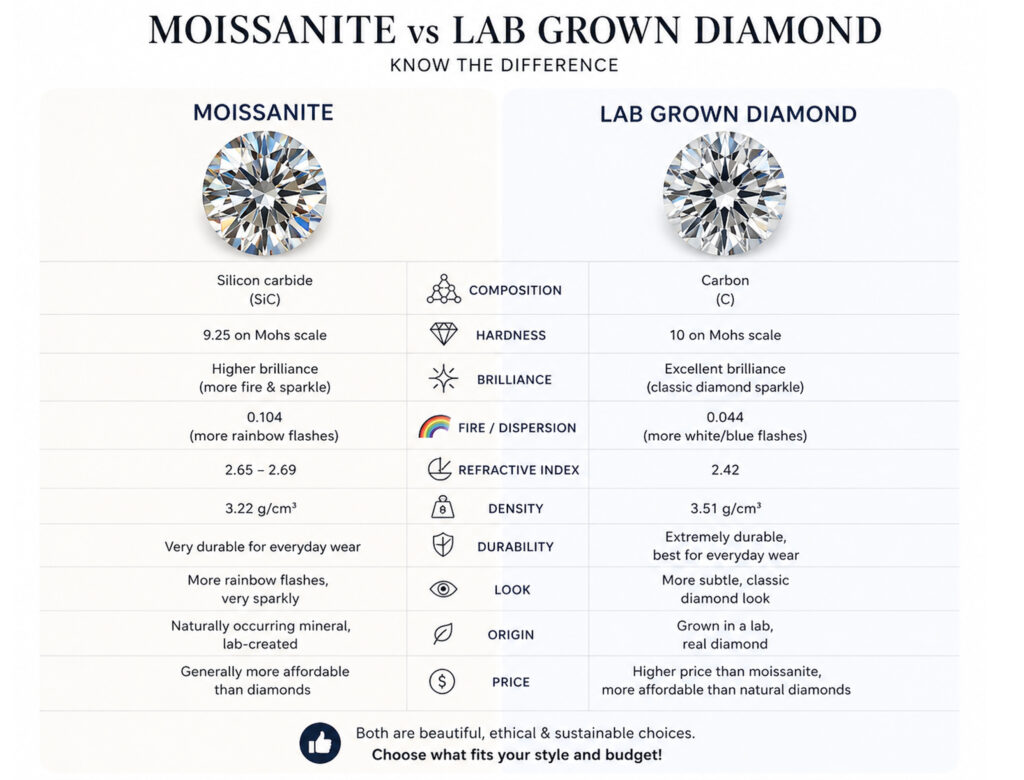
Moissanite is a different gemstone (silicon carbide), not a diamond, and it is not graded on the official diamond clarity scale by major diamond labs. Most good moissanite is sold as “VVS equivalent”, meaning it is eye-clean and very clean under magnification. If your customers want the VVS look at the lowest cost, moissanite is worth comparing; our lab-grown diamond vs moissanite guide explains the trade-offs.
Quick buying checklist
- Choose cut first, then colour, then clarity.
- For brilliant shapes, VS2 is usually all you need; VS1 for extra peace of mind.
- For step cuts over about 1.5 ct, move up to VS1 or VVS.
- Use VS for melee and multi-stone pieces; consistency matters more than grade.
- Ask for a certificate (IGI or GIA) on centre stones so the clarity is verified.
- Always confirm whether a stone is natural, lab-grown or moissanite.
- Compare VVS vs VS diamonds side by side under normal light before you decide; most buyers cannot pick which is which.
Frequently asked questions
Can you see the difference between VVS vs VS diamonds?
Not with the naked eye in almost all cases. The difference is only visible under 10x magnification, and even then it takes a trained eye.
Is VS2 good enough for an engagement ring?
Yes, for round and other brilliant shapes VS2 is typically eye-clean. For large emerald or Asscher cuts, VS1 or VVS is safer.
Is a VVS diamond more durable?
No. Durability depends on the diamond itself and on avoiding large surface-reaching feathers, not on the difference between VVS and VS.
Why do hip-hop jewelers always say VVS?
Because the term has become a strong selling point. It signals top quality to customers, even though VS stones look the same once set.
Do lab-grown diamonds use the same clarity grades?
Yes. IGI, GIA and other labs grade lab-grown diamonds on the same FL-to-I scale, and the report states that the diamond is laboratory-grown.
Need VVS or VS stones for your collection?
Whichever side of the VVS vs VS diamonds question you land on, Bluequeen Jewels manufactures lab-grown diamond and moissanite jewelry in both clarities for retailers and brands across the USA, UK, Australia and UAE. Contact us for a quote, or see our wholesale program.