
The lab grown diamond disclosure rules that apply to US jewelry sellers are more specific than most retailers realise, and the most common violations are wording choices that sound completely harmless. If you sell lab-grown, the words on your product page, your invoice and your Instagram caption are all covered.
This is general information for jewelry businesses, not legal advice. If you are unsure about a specific claim, ask a qualified attorney.
Why this matters more in 2026
Lab-grown has stopped being a side category. JCK reports that lab-grown inventory at US jewelry retailers has risen from single digits as a share of sales in 2020 to roughly half. That is a very large number of listings, tickets and social posts describing stones — and every one of them is a place where wording can go wrong.
What the FTC Jewelry Guides actually are
The Guides for the Jewelry, Precious Metals, and Pewter Industries, usually just called the Jewelry Guides, set out how the Federal Trade Commission interprets deceptive practice in jewelry marketing. They are guidance rather than a standalone statute, but they show how the FTC applies Section 5 of the FTC Act — so treating them as optional is a poor bet.
The 2018 revisions did the most relevant work. They removed the word “natural” from the basic definition of a diamond, acknowledging that diamonds are now produced by more than one method, and added guidance on qualifying claims for man-made stones, composite gemstones, treated pearls, and precious metal alloys below traditional thresholds.
The lab grown diamond disclosure rules in practice
Terms you can use
The FTC points to three qualifying descriptors, as summarised by National Jeweler:
- Laboratory-grown
- Laboratory-created
- [Manufacturer name]-created
Any other wording is acceptable only if it clearly and conspicuously conveys that the stone was not mined. “Synthetic” was dropped as a recommended term in the 2018 revisions but was not banned — it is usable provided it does not imply the product is fake.
Terms you cannot use
Words such as real, genuine, natural, precious and semi-precious cannot be used to describe laboratory-grown diamonds or other artificially produced stones. This trips up a lot of well-meaning copy, because “a real diamond, just grown in a lab” feels like an honest sentence. Under the guides it is not.
Note also that the unqualified word “diamond” still refers to a mined stone. Using it alone for lab-grown — including in a hashtag such as #diamonds — can imply mined origin.
The “cultured” trap
“Cultured” on its own is not sufficient. If you use it, it must be immediately accompanied, with equal prominence, by one of the three recommended terms above. “Cultured diamond” in a headline with “laboratory-grown” in small print further down does not satisfy that.
Where the disclosure has to appear
This is where most sites fail. The disclosure must be clear, conspicuous and close to the product claim itself. The FTC has specifically criticised sellers who put origin information only on a separate “diamond education” page rather than in or near the advertisement.
Practically, that means the qualifying term belongs in the product title and the first line of the description — not only in a specification table below the fold, and not only in an FAQ. The same applies across every medium you use: website, printed material, social posts, hashtags, spoken conversation in store, invoices, contracts, reports and receipts.
Environmental claims are a separate trap
Calling lab-grown “eco-friendly”, “green” or “sustainable” without substantiation falls under the FTC’s Green Guides, and unqualified environmental claims are difficult to support. The FTC has also flagged terms such as “grown” without “laboratory”, “greenhouse” and “ethically-grown” as potentially misleading. If you want to make an environmental claim, make a specific and provable one, or make none.
Simulants are not lab-grown diamonds
Moissanite and cubic zirconia are diamond simulants — different materials with different optical and physical properties. They must not be described in ways that falsely imply they are the same as a diamond, mined or grown. If you stock moissanite jewelry, describe it as moissanite, plainly, and let its own qualities do the selling.
A practical checklist for your listings
- Does the product title contain “lab-grown” or “laboratory-created”?
- Does the first line of the description repeat it?
- Have you removed real, genuine, natural, precious from all lab-grown copy?
- Do your hashtags and social captions disclose, not just the website?
- Do your invoices and receipts state the stone type?
- Are environmental claims specific and evidenced, or removed?
- Are simulants labelled by their own name rather than as a diamond variant?
- Do your product photos and alt text avoid implying mined origin?
What to require from your supplier
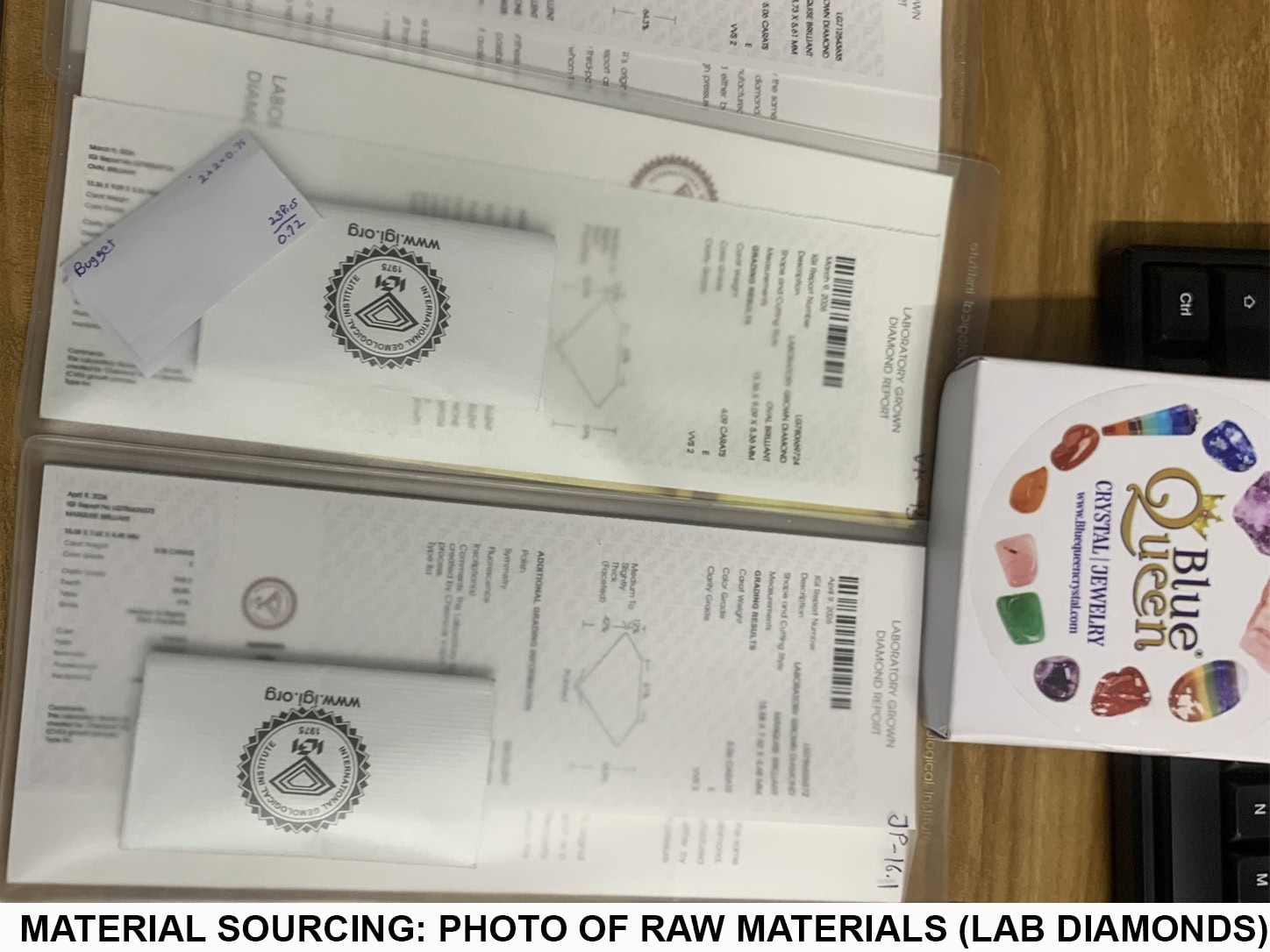
Compliance is easier when the paperwork arrives correct. When you buy lab-grown diamond jewelry or loose lab-grown stones wholesale, ask for the stone type stated explicitly on the invoice and packing list, grading reports that identify the growth method, consistent terminology in any copy or imagery the supplier provides for resale, and written confirmation of metal karat and weight. A supplier who describes goods loosely to you will leave you writing the disclosure from guesswork. Our wholesale programme and the wider picture in our 2026 wholesale jewelry trends analysis cover what else to agree up front.
Frequently asked questions
Can I call a lab-grown diamond a “real diamond”?
No. The FTC guides specifically exclude real, genuine, natural, precious and semi-precious as descriptors for laboratory-grown stones. You can say a lab-grown diamond has the same chemical and optical properties as a mined one — that is accurate and permitted — but not that it is a “real diamond”.
Is “synthetic diamond” allowed?
It is not prohibited, but it was removed as a recommended term because many consumers read “synthetic” as “fake”. “Laboratory-grown” or “laboratory-created” is safer and clearer.
Do the rules apply to social media?
Yes. Disclosure obligations follow the claim, not the channel, and that includes captions, hashtags and video. A compliant product page does not fix a non-compliant post.
Does this apply if I sell outside the United States?
The FTC guides govern US marketing. Other markets have their own regimes — the UK, EU and Australia each handle lab-grown naming differently — so if you sell internationally, check the rules for each destination rather than assuming the US position travels.
The short version
Disclose the growth method in the title, disclose it again in the first line, keep the words real and genuine out of lab-grown copy entirely, and make sure every channel says the same thing. That covers the great majority of the risk, and it costs nothing except a careful pass through your listings.